Café scene in the market square (Place Charles de Gaulle)
Showing posts with label days out. Show all posts

Thursday, April 19, 2012

A light lunch at Aubeterre-sur-Dronne


You can't deny it, Aubeterre-sur-Dronne does have a very quaint square

I have mentioned before that one of the more pleasant aspects of our work (running a B&B) is the need to research and, in particular, the local restaurants and places of interest so that we may be able to give first hand advice to any of our guests should they ask us.  This was why we recently found ourselves seated at 'La Taverne' restaurant nestled on the cliff face at Aubeterre-sur-Dronne yet another of Les Plus Beaux Villages de France. This building was once the home of the famous French crime/mystery writer, Pierre Véry.  Many of his books were made into successful films.


The perfect wine to accompany our light, early Spring lunch

We were lucky enough to be able to find a table on the upper terrace of La Taverne with lovely views down the valley and after being greeted by our host, the warm and friendly patronne, Carmen Hollander, we settled down to our lunch surrounded by, what seemed, mostly local French people doing the same.  We chose a half bottle of Graves de Vayres 2007 as an accompaniment to our meal and after tasting this we are now going to do a little more investigation at the Château. 


What a starter!  Home made quiche with a perfectly browned top


The main course, with the toasted panini in the background


This orange and citron tart was a great finish

We kicked off with a fine home made quiche, beautifully browned with grated cheese on top with a few haricots verts and parsley butter on the side.  Really, really nice and a very promising start.  The quiche was followed by toasted goats cheese, garlic and tomato served with a light but copious salad.  This was perfect for a very hot day, so hot in fact we were glad of the shade of the terrace.  The dessert was a well balanced sharp orange and citron tart, great for cleansing the palate.  At 12 euros per head without the wine we both thought this fantastic value.  If you factor in the view and ambience the value gets even better.  Highly recommended. 


Carmen looking justly proud of what she has achieved here at 'La Taverne'

All sated we left 'La Taverne' and wended our way up into the town marvelling at Aubterre's architecture.  It's a beautifully maintained town, currently undergoing a renovation of the paving in its main square where a small but interesting market is held on Sunday mornings.  There are lots of interesting buildings in labyrinthine to captivate one's attention.  Aubeterre is blessed with two wonderful churches.  Rightly famous for its subterranean, monolithic church, Saint Jean, with its wonderful frescoes which adorn the door each telling a different story, it has another equally interesting church in that of Eglise Saint Jacques;  next time you visit Aubeterre make sure you take time to visit this less well-known cousin of Saint Jean.


The magnificent Romanesque portico of Eglise Saint Jacques in Aubeterre


Every fresco tells a story

Wednesday, April 18, 2012

Quai des Chartrons on a sunny morning


This guy sure knows how to travel

There really is no better place to be on a Sunday.  If the sun is shining all the better.  The Quai des Chartrons on Bordeaux's revitalised riverside is the height of chic and Lesley and I try and get down there whenever our work permits.  So on a recent Sunday with the sun shining down favourably we decided to lunch on the quayside. 


These banana boxes caught my eye,  maybe in an earlier time bananas would have been discharged riverside in Bordeaux

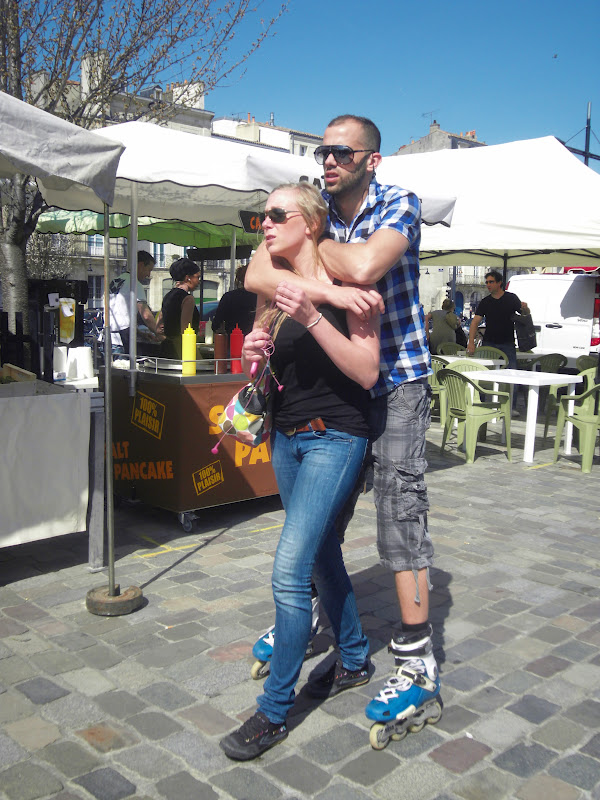
We have worked out that the most convenient way to get there is to take Bordeaux's state of the art tram system.  Park the car up at Le Buttinière and take advantage of the P&R (park and relax) option before dropping down into the city on a tram.  Marvel at Bordeaux's superbly preserved skyline as you glide across the Pont de Pierre before alighting at the Porte de Bourgogne.  Carefully cross the tram tracks before arriving at the Quai des Querries.  Here you can gently join the crowds and head westwards up the prom.  These Sunday morning people utilise all forms of transport to negotiate the quayside.  We observed monobikes, skateboards, rollerblades, rollerskates, and cycles; some people even walk. 


The Bordelais, totally chilled


This local looks a little bemused by it all

Young families are much in evidence, often pushing the latest labelled buggy.  The 'wheelie' people weave gracefully in and out of the walkers as they take their Sunday morning constitutional.  Along the way people stop to pause and chat with their friends enjoying a glass of wine or an oyster or two.  The promenade is thronged with market stalls representing all types of world cuisine vying with one another to capture a piece of this passing trade.  The place hums with activity and great vibes. 


Slightly more interesting than a MacDo


All your food needs are catered for on the Quai des Chartrons

Lesley and I chose a light lunch of flambeed crevettes flash fried with whisky and rosemary accompanied by a couple of glasses of Entre-Deux Mers, If you haven't tried this combination yet, you must.  It's really delicious, but make sure your crevettes are décortiquées. We were lucky enough to find a stall selling really lovely fresh bread and bought a beautifully crispy tourte as part of our lunch.  Finding a table to sit down at was a little more tricky, but Lesley's persistence paid off in the end and we were able to bag a table for two under a conveniently placed umbrella.   The pace is slow and it's a fascinating exercise to sit and enjoy one's lunch whilst undergoing a bit of people watching.  And believe you me, there is plenty here to hold and amuse you as Bordeaux goes about its usual Sunday morning ritual.  


This interesting building close to the Quai looks a little North African


The morning after the night before a la Bordelais.  You would think the recipient of this shoe might have realised he was hopping home minus one very expensive shoe

Sunday, April 15, 2012

Salies de Béarn and beyond to Bayonne


Salies de Béarn - picture postcard stuff

Lesley and I continued our tour of the south west and and turning westwards from Pau, headed in the direction of Salies de Béarn.  This little gem of a town numbering about 5,000 people sits in the middle of beautiful rolling countryside.  Its lovely 16c and 17c houses contained in a myriad of twisty turny little streets are evidence of the town's past activities and economic position.  Salt is supposed to have been sourced here for over 3,000 years.  This and its magnificent Victorian thermal baths are what has brought in the tourists that keep Salies alive today. 


There are so many interesting and beautiful buildings in Salies de Béarn

Since its heyday around the early 1800s when the population was double what it is today, it seems to have settled contentedly into its current niche and unlike a lot of other French towns of a similar size appears remarkably prosperous.  During the war those same twisty turny streets echoed to the sound of the jackboot, for the demarcation line between occupied and unoccupied France ran right through this commune.  


Another example of local architecture

We reluctantly left this unspoilt town under perfect blue skies and then headed for the extreme left hand corner of l'Hexagon.  There huddled under the Pyrenees and abutting the Atlantic ocean to the west lies Bayonne.  Straddling both sides of the river Nive, Bayonne has an important place in the history of France.


The Basques are passionate about their politics


The main post office in Bayonne, French post office architecture with its distinct art deco style

Once ruled by the English for over two hundred years, thanks to Henry II's marriage to Eleanor of Aquitaine, and now proudly Basque, it attracts many tourists heading for the south and Spain or to the extremely chic resorts of St Jean de Luz, Angelet and Biarritz.  Its position is key to its relative current prosperity.  Parking down by the river Lesley and I climbed up towards the heart of the old town, admiring the many timbered buildings dressed in that Basque red and also passing Vauban's fortifications on the way.  If we English refer to Pepys from this epoch and his influence on the birth of the technology we recognise today, then the French can refer to Vauban, a master miltary architect if ever there was one.  France is dotted with examples of his fortifications.  Visit Blaye to view a particularly fine example. 


The world renowned Bayonne ham, there is nothing quite like it


A picturesque Bayonne café and tea shop


and within, all the teas of the world

Having bought some of the famous Bayonne ham, a speciality ham cured with the famous red peppers from Espelette, we settled down at a riverside cafe to enjoy a beer.  We were surrounded by a lot of confident young people enjoying themselves, seemingly sure of their traditions and 'Basqueness'.  A couple of young men even gave a lesson in the latest rugby scrum technique, grappling about with much amusement.  All done without a drop of beer or wine being spilt.  Life was to be enjoyed and they appeared to have a healthy attitude towards it. 


The young of Bayonne relaxing and socialising

On this positive note we reluctantly left Bayonne, our spirits much lifted and pointed the car towards the black and glowering pine forests of 'Les Landes'.  Gawp at all these pine trees in wonder and then consider this;  that before the 18c this was all mostly swampland and that the nearly 4,000 sq miles of trees have been entirely planted by man.  Truly incredible.

We bought an interesting aperitif in this shop.  Named Le Pimencon it is an interesting concoction of an Espelette pepper floating in a base of white wine.

Sunday, April 8, 2012

Cahors - a medieval city on the River Lot


Everybody's favourite, my version of the famous Valentré bridge which was 70 years in creation (1308-1378)

After a very pleasant sojourn in St Cirq La Popie, Lesley and I headed west into the departmental capital of the Lot, Cahors.  Naturally enough I've always associated this medieval gem, which hosts the most complete example of a medieval fortified bridge in France, with the local wine.  Famous for its deep ruby colour, it is known as 'the black wine, but more of this later.  Wandering around the dark and brooding 15th and 16th century streets we were reminded of Barcelona's old town; four and five storey buildings hanging over narrow streets and passages where the sun never shines.  Take time to crick your neck and look skywards, quite often that is where the more interesting aspects of architecture are to be found.  The example of a Renaissance window in the photograph below is a case in point.  All that craftsmanship and skill lost to most passers-by.  The only people who really benefit from this are the neighbours who live opposite.  Not a view of the mountains  or forests maybe but definitely a room with a view.  The photograph also shows the type of building material used in this area.  In the Dordogne it's all limestone.  Further south towards Sarlat-le-Caneda it changes to sandstone with a redder hue.  In Cahors it's a type of red brick, somewhat similar in size and colour to its English Tudor counterpart.  I often wonder who actually lives in these buildings and what work (if any) do they do.  One rarely observes anybody coming or going but life exists there as it has done for at least 400 years. Presumably now there is less need to avoid the emptying of chamber pots from those elaborate windows into the streets below.


I think this outstanding example of Italian influence architecture was up on the 3rd floor


This old signage caught my eye amongst the narrow back streets

The cathédrale Saint Étienne's omnipotence is apparent as it rises above the old quarter.  Finished in about 1135 the building has a fortified air about it.  Not surprising really as at the time  Cahors was run by local bishops who were also acting as feudal barons and landlords.  An analogy with the despotic mandarins now holding sway over Europe in the crumbling edifice of fortress Brussels comes to mind.


Saint Etienne Cathedral rises above the Saturday morning market


French markets like the one in Cahors are much more than just about buying 


It could be Brick Lane

The Cathedral's north portico looks out over the Place Jean Jacques Chapou and every Saturday a very lively and authentic market completely subsumes the space.  A bit like Ribérac market, most things are available here.  On the day Lesley and I were present we had the sense that we were the only tourists and that this was a place well patronised by 'Les Cadurcians'.  Heated and animated discussion was all around as everything from the weather to the price of tomatoes was dissected.  Lesley and I both thought that some of the reasons we loved Cahors were its authenticity and a working atmosphere. Evidently a multicultural society exists here and it seems for the most part, the different ethnic groups rub along happily.  Unfortunately, like so many French towns and cities it does suffer from more than its fair share of grafitti.  Cruel to witness on all that Renaissance stone and brickwork.


21c meets 15c in a typical Cahors back street

One of the market stalls I felt drawn towards was that of Jean-Jacques Bousquet, vigneron, récoltant and proprietor of Domaine de la Garde.  Here I was able to taste some of Jean-Jacques finest.  His wines were very approachable for drinking now or, because of their robustness with a fine balance of tannins, just as good for keeping.  Jean-Jacques vineyard lies outside Cahors 12 kms to the south west.  Here he grows the famous Malbec or Auxerrois grape that dominates the cepage alongside its cousins the Merlot and Tanat.  The grapes are grown by the Lot and up on the Causse itself.  The Causse is an area of harsh exposed limestone plateau where the sun beats down relentlessy and the wind scours.  It is this that makes the wine so distinct as the vines battle it out with the elements. 


Jean-Jacques Bousquet enthuses about his wines

The Malbec grape is what gives Cahors wine its tannins and therefore its ability to age, and age really well.  At one time the Malbec grape covered a far greater area of south-west France than it does now, right down to Bordeaux itself.  Now, the Cahors vineyards are the only remaining stronghold of this unique grape variety.  Try a 15 or 20 year old Cahors wine and you will understand what I mean, truly sublime.  What has been France's loss has been Argentina's gain.  For the Malbec grape has found a new spiritual home in Mendoza, Argentina where it rules the roost often under ex-pat French vignerons who have exported their wine making skills to the land of steak and gauchos.  Apparently it is going from strength to strength here and flourishes under south American climatic conditions.  So having bought a few bottles of Jean-Jacques selection and also some fine local goat cheese, Lesley and I headed off south-west, towards the Quercy and a circuitous route back to Ribérac


These gourds make great decoration and last for ages


The French never miss an opportunity to promote their produce, like these Malbec vines growing alongside the Pont Valentré


A short step from the market takes you to the Place Charles de Gaulle.  Here you will find this very special charcuterie.  We tried the interesting myrtle, garlic and (my favourite) Roquefort flavoured speciality 'fait maison' saucissons


Tuesday, April 3, 2012

St Cirq Lapopie - the pearl of the Lot valley


The fortified church of St Cirq Lapopie proudly surveys the Lot valley

A little over a month ago Lesley and I found ourselves in the deepest Lot in the south-west of France  about 30 minutes by car from Cahors.  The Lot valley is a wonderful place, deep valleys, steepling chalky cliff faces that climb craggily ever upwards.  Awe inspiring looking skywards from the river but truly gut clenching when viewed whilst perched on top.  The village of St Cirq Lapopie must surely hold the most dominant position on this part of the river and one can clearly see why early settlers would have chosen this point to live, for from here one could control the river traffic navigating the river Lot, west down to Cahors or up river towards Rodez in the east. 


It could be Tuscany, the eglise de St Cirq Lapopie looks more fortress than church

St Cirq would have been virtually impossible to storm from below so in effect all that had to be done was to keep a keen eye on the plateau at the top.  With so many of this type of fortified hill village in Europe and beyond, one is left marvelling at how exactly the building of great structures such as the fortified church of St Cirq actually came about.  It must have come down to courage and a blind faith in the Almighty for no crampons, carabiners or nylon ropes were on hand to assist these early men who lived out their lives 'dans les falaises' 


The river Lot snakes westwards down to Cahors

There is now only one major point of fortification in St Cirq, the fortified church, which now overlooks everything. In the middle ages there were two others, one owned by the Cardaillac family, evidence of which surrounds the church, and another belonging to the Lapopie family.  This is the one that takes the highest viewpoint in the village climbing up to a small rocky viewing terrace, an eyrie which looks down onto the church to the left and then tumbling down on into the river far below.  I don't think I would have had the courage to present an estimate or devis for this build to the Lapopie family had I been a local builder at the time.


The smoke bears evidence that a few people still live in St Cirq Lapopie


All higgeldy-piggeldy in the early morning light

At our hotel which nestled at the other side of the river with magnificent views up to the village on the other side, we were reliably informed by the receptionist that only about 10 houses in St Cirq are now occupied, everything else being artists workshops and restaurants. On the beautiful early March morning we ascended into the village about five of them had smoke drifting from their stacks accompanied by the heady smell of burning well seasoned oak.  There's nothing quite like it on an early spring morning. 


 St Cirq lies within the community of St Gery.  The railway used to run from Figeac to Cahors.  This section through the cliffs was cut out between 1880 and 1883.


This redundant tunnel goes a long, long, long way into the cliff,  pack some sandwiches and take a torch

In some ways so little has changed.  One could almost hear the medieval wood turners and tanners at work.  The tiny port at the foot of the cliffs would have allowed for their goods to move up and down river allowing commerce to prosper.  These early artisans must have been rather good at exercising their craft and the money they made is reflected in the quality of the houses built here.  This spectacular village rightly holds its title as 'Un des plus beaux villages de France"


The view from our hotel bedroom window early one morning.  The vines are gathering themselves for the warmer weather to come


No doubt about it, breathtakingly beautiful in the early morning light of March

Saturday, March 31, 2012

Riberac's 2nd Gastronomie Festival


Beautifully packaged and displayed, Clovis Reymond founded in 1834 at Villamblard produce liquers, bottled fruit & syrups

For the second year running the sunshine played its part in Ribérac's Printemps du Gastronomie.  The day broke clear, cold and bright with a peerless blue sky which quickly stamped its authority on the proceedings.


The Pâtisserie Bordelaise and their display including the regional treats known as cannelés

I passed through the Place de Gaulle a little before 8.00 am amid the hustle and bustle of exhibitors and organisers readying everything for the long day ahead.  The French are particularly good at this sort of thing.  They are well versed in the assembling and dismantling of stalls, marquees, display stands etc.  The work always seems to be carried out under a cheerful banter between old friends or new acquaintances accompanied by a swirl of cigarette smoke and small black coffees.  I suppose the nearest UK equivalent is the setting up of the ubiquitous 'car boot' in Farmer Giles spare field, on a sunny Sunday morning whilst sipping a cuppa and dissecting yesterday's football results.


Peter, proudly representing a vital part of the Périgord's  heritage and gastronomy

When Lesley and I arrived at about 11.00 it was already apparent that this year's event was going to be so much better patronised than in 2011.  Word appears to be out and it was really heartening to see the square already full of local people, young and old alike, enjoying themselves in the glorious heat of an early spring mini-heatwave. Indeed as the temperature mounted and my mind started to wander to something cold in a glass my eye was caught by some strange looking people wandering around, dressed in heavy cloaks draped with leather around the shoulder, thick hats, and carrying stout wooden staves.  Are they mad? Are they Brits? Are they Morris Men who've lost their way?  Well, a bit of both really.  I was introduced to Peter and his wife Susan, resident British in France and belonging to and supporting something known as 'Confreries'.  To understand this fraternity or brotherhood one must think of the Trade Guilds in the UK who represent such diverse things as woodturning, stone masonry, embroidery etc.  Naturally enough in  France it's all about food and drink.  Peter and Susan's particular speciality is cêpes and everything relating to them.  It's a serious business and you have to be commited to and believe in your cause.  No lightweights need apply.  Really it's all about promoting and supporting local produce and keeping a way of life alive and kicking in the 21st century.  Representing 'Les Confréries' at Ribérac were the brotherhoods of Raisins d'or Sigoulés (golden raisins of Sigoulés), Paté de Périgueux and the Dolte Collége de la truffe et du foie gras du Périgord.  What a perfect cross-section of the wonderful foodstuffs produced in the green and fertile land that is the Périgord.


The lovely Liliane from Holland, resplendent in her ceremonial attire


A family taking part in the best picnic set-up competition

Wine producers were well represented from such diverse regions as Bergerac all the way down to the Tarn department far away to the south east of Ribérac.  I got chatting to a young wine producer from Bergerac, Frédéric de Monner from Château Sanxet.  Frédéric informed me that he had studied Law at the University of Bordeaux but now felt that, in his own words "I want to get my hands dirty."  So, here was a young man, obviously well educated,  who instead of burying his head in law books wanted to work the terroir.  He produces red, dry white and a really nice subtle Monbazillac.  He told me with evident excitement that he had only got to bed at 3.00 am that morning due to the bottling of his very first recolte, that of 2011.  My best wishes go out to Frédéric for it is people like him that give me hope for the future of France's wine production.  Try his lovely red, a 2010 Cuvée Barrique. 


Frédéric de Monner waxing lyrical about his wines

Another interesting couple passionate about their products are M. et Mme Brureau from the Domaine de Peyres-Combes which falls under the Gaillac appellation in the Tarn.  Victor Brureau hails from the island of Guadeloupe and it was what he saw there with the industrial production of bananas and the chemicals involved in this process that convinced him that organic or Bio production was the only way forward.  A Domaine highly recommended because of the belief and passion that this couple have been putting into their product since commencing its production in 1988, long before organic production was fashionable.  It was a long drive for these particular exhibitors and I like to think I did my little bit to support them.


M.and Madame Brureau passionate about their bio-wines from Gaillac

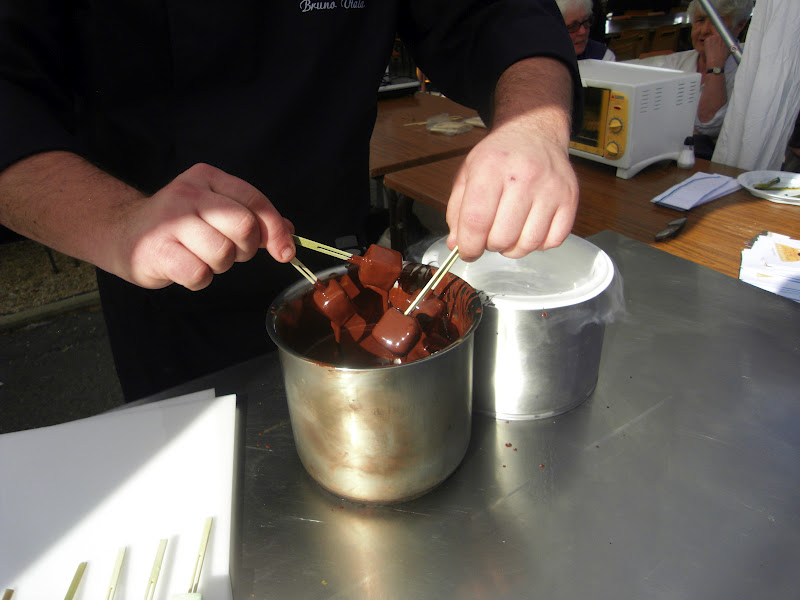
This year Ribérac was blessed with the presence of several renowned chefs who arrived to reveal the secrets of their cooking.  I was particularly interested in Parisien chef Bruno Viala and his interpretation of a style of cooking known as 'cuisine moléculaire'.  This entails freezing by the process of liquid nitrogen.  He presented mint marshmallows which he popped fleetingly into a canister of nitrogen before dipping them into a luxury, liquid chocolate.  Once coated in the chocolate he then popped them back into the nitrogen which froze the chocolate, making them into a marshmallow version of a choc-ice.  I sampled more than one of these and trust me, they were really, really delicious.  It seems that what makes a great chef or cook is their ability to think in a different way, to be able to produce something unusual and then present it in an interesting style.  This is precisely what Monsieur Viala did.


Go on, take one, you know it's good for you


Bruno Viala showing us all about 'cuisine moleculaire'

It fell upon one time French Masterchef quarter finalist Phillipe Mesuron to entertain the children.  He took  on (quite happily it seemed) the challenge of organising a large group of local children and directing them in the fabrication of a melted caramel mix blended with cooked bananas.  This entailed groups of children all dressed in chefs fatigues wrestling with pans full of melted down Haribos which sat atop very hot stoves.  The H&S Executive police in the UK would have come down on such a situation like the proverbial ton of bricks.  The children chatted and laughed amongst themselves, one even seemed to sustain a small burn to her arm, but then just grimaced before getting on with the job in hand, the making of lots of sticky sweet stuff.  The children all lost themselves in the experience and one could tell that the kitchen environment was not an alien place to them.  


Philippe Mesuron passing on his culinary tips to the younger generation


This young lady is quite at ease slaving over a hot stove in temps of nearly 30 degrees

Back for the second year was local chef Fabrice Morel representing his establishment at Aubeterre-sur-Dronne, Hostellerie de Périgord.  Fabrice is a great believer in the promotion of locally sourced ingredients and this is always evident in his menu.  He has the knack of using products such as foie gras or beef and presenting them in such fashion that they don't appear heavy and overbearing.  He has modernised the use of such ingredients and last Saturday was a case in point where he cooked a 'Boeuf-en-portfeuille'. 


Fabrice Morel turning out his pancakes under the watchful eye of master of ceremonies, Jean François Bittard aka Jeff


Fabrice and his team of Romaine and Karim bringing it all together

Basically this involved flash frying a quality piece of beef with added rock salt.  It was then sliced through the middle ready to receive a slice of home-prepared foie gras which had been lightly scored and sautéed in sesame oil.  Meanwhile, whilst Fabrice was busy with the meat Romaine set about prepping up some mini pancakes made with sesame seeds.  Karim got very busy dissecting some fresh lime, lemon, red onion, chinese leaf, radish, lemongrass and finally (a nice touch this) a habenero pepper.  All this was finely chopped and put into square shaped moulds before being plated up along with the steak and foie gras pancake 'sandwich'.  A really innovative dish which tasted wonderful and an inspiration in the use of such ingredients as beef and foie gras.


Fabrice, Karim and Romaine take the applause.  Photo courtesy of Ben Morel


The day swung along to the traditional music of Huguette and Michel Lorin and friends 

Hopefully the 'Festival Printemps de la Gatronomie' is going to become a regular feature in Ribérac's calender and go from strength to strength.  See you next year!