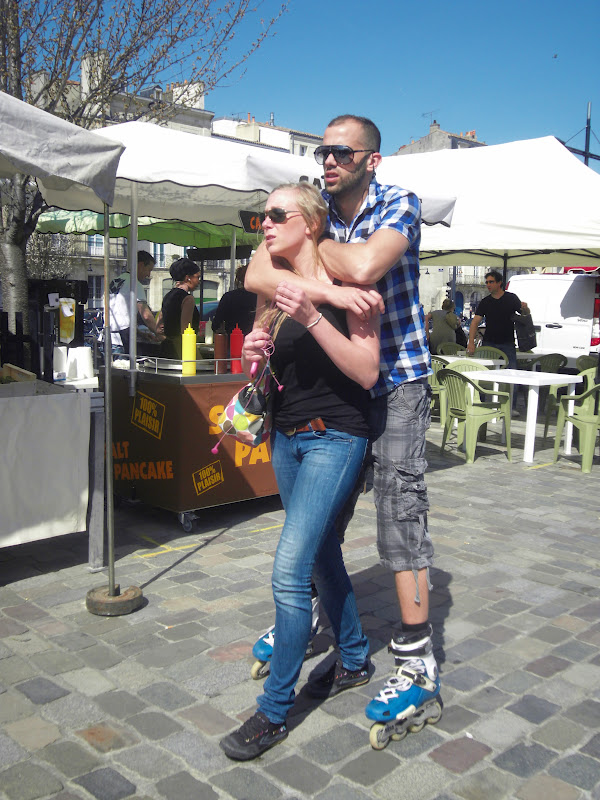
Café scene in the market square (Place Charles de Gaulle)
Showing posts with label other areas of France. Show all posts

Wednesday, April 18, 2012

Quai des Chartrons on a sunny morning


This guy sure knows how to travel

There really is no better place to be on a Sunday.  If the sun is shining all the better.  The Quai des Chartrons on Bordeaux's revitalised riverside is the height of chic and Lesley and I try and get down there whenever our work permits.  So on a recent Sunday with the sun shining down favourably we decided to lunch on the quayside. 


These banana boxes caught my eye,  maybe in an earlier time bananas would have been discharged riverside in Bordeaux

We have worked out that the most convenient way to get there is to take Bordeaux's state of the art tram system.  Park the car up at Le Buttinière and take advantage of the P&R (park and relax) option before dropping down into the city on a tram.  Marvel at Bordeaux's superbly preserved skyline as you glide across the Pont de Pierre before alighting at the Porte de Bourgogne.  Carefully cross the tram tracks before arriving at the Quai des Querries.  Here you can gently join the crowds and head westwards up the prom.  These Sunday morning people utilise all forms of transport to negotiate the quayside.  We observed monobikes, skateboards, rollerblades, rollerskates, and cycles; some people even walk. 


The Bordelais, totally chilled


This local looks a little bemused by it all

Young families are much in evidence, often pushing the latest labelled buggy.  The 'wheelie' people weave gracefully in and out of the walkers as they take their Sunday morning constitutional.  Along the way people stop to pause and chat with their friends enjoying a glass of wine or an oyster or two.  The promenade is thronged with market stalls representing all types of world cuisine vying with one another to capture a piece of this passing trade.  The place hums with activity and great vibes. 


Slightly more interesting than a MacDo


All your food needs are catered for on the Quai des Chartrons

Lesley and I chose a light lunch of flambeed crevettes flash fried with whisky and rosemary accompanied by a couple of glasses of Entre-Deux Mers, If you haven't tried this combination yet, you must.  It's really delicious, but make sure your crevettes are décortiquées. We were lucky enough to find a stall selling really lovely fresh bread and bought a beautifully crispy tourte as part of our lunch.  Finding a table to sit down at was a little more tricky, but Lesley's persistence paid off in the end and we were able to bag a table for two under a conveniently placed umbrella.   The pace is slow and it's a fascinating exercise to sit and enjoy one's lunch whilst undergoing a bit of people watching.  And believe you me, there is plenty here to hold and amuse you as Bordeaux goes about its usual Sunday morning ritual.  


This interesting building close to the Quai looks a little North African


The morning after the night before a la Bordelais.  You would think the recipient of this shoe might have realised he was hopping home minus one very expensive shoe

Sunday, April 15, 2012

Salies de Béarn and beyond to Bayonne


Salies de Béarn - picture postcard stuff

Lesley and I continued our tour of the south west and and turning westwards from Pau, headed in the direction of Salies de Béarn.  This little gem of a town numbering about 5,000 people sits in the middle of beautiful rolling countryside.  Its lovely 16c and 17c houses contained in a myriad of twisty turny little streets are evidence of the town's past activities and economic position.  Salt is supposed to have been sourced here for over 3,000 years.  This and its magnificent Victorian thermal baths are what has brought in the tourists that keep Salies alive today. 


There are so many interesting and beautiful buildings in Salies de Béarn

Since its heyday around the early 1800s when the population was double what it is today, it seems to have settled contentedly into its current niche and unlike a lot of other French towns of a similar size appears remarkably prosperous.  During the war those same twisty turny streets echoed to the sound of the jackboot, for the demarcation line between occupied and unoccupied France ran right through this commune.  


Another example of local architecture

We reluctantly left this unspoilt town under perfect blue skies and then headed for the extreme left hand corner of l'Hexagon.  There huddled under the Pyrenees and abutting the Atlantic ocean to the west lies Bayonne.  Straddling both sides of the river Nive, Bayonne has an important place in the history of France.


The Basques are passionate about their politics


The main post office in Bayonne, French post office architecture with its distinct art deco style

Once ruled by the English for over two hundred years, thanks to Henry II's marriage to Eleanor of Aquitaine, and now proudly Basque, it attracts many tourists heading for the south and Spain or to the extremely chic resorts of St Jean de Luz, Angelet and Biarritz.  Its position is key to its relative current prosperity.  Parking down by the river Lesley and I climbed up towards the heart of the old town, admiring the many timbered buildings dressed in that Basque red and also passing Vauban's fortifications on the way.  If we English refer to Pepys from this epoch and his influence on the birth of the technology we recognise today, then the French can refer to Vauban, a master miltary architect if ever there was one.  France is dotted with examples of his fortifications.  Visit Blaye to view a particularly fine example. 


The world renowned Bayonne ham, there is nothing quite like it


A picturesque Bayonne café and tea shop


and within, all the teas of the world

Having bought some of the famous Bayonne ham, a speciality ham cured with the famous red peppers from Espelette, we settled down at a riverside cafe to enjoy a beer.  We were surrounded by a lot of confident young people enjoying themselves, seemingly sure of their traditions and 'Basqueness'.  A couple of young men even gave a lesson in the latest rugby scrum technique, grappling about with much amusement.  All done without a drop of beer or wine being spilt.  Life was to be enjoyed and they appeared to have a healthy attitude towards it. 


The young of Bayonne relaxing and socialising

On this positive note we reluctantly left Bayonne, our spirits much lifted and pointed the car towards the black and glowering pine forests of 'Les Landes'.  Gawp at all these pine trees in wonder and then consider this;  that before the 18c this was all mostly swampland and that the nearly 4,000 sq miles of trees have been entirely planted by man.  Truly incredible.

We bought an interesting aperitif in this shop.  Named Le Pimencon it is an interesting concoction of an Espelette pepper floating in a base of white wine.

Thursday, April 12, 2012

Pau - gateway to the Pyrenees


This is a fine example of classical Paloise architecture

We have heard a lot about Pau over the years so were keen to see what it was all about. We had located ourselves slightly uptown, that is to say a 10 minute walk north from the Boulevard des Pyrénées squares and main shopping centre in a beautiful Paloise style house belonging to Agnes and Benoit which they run as a B&B.  Pau is the birthplace of Henri 1V or Henri of Navarre and the overly restored chateau where he was born still stands proudly overlooking the Pyrenees a few miles to the south.  


Agnes and Benoit's house where we stayed, interesting isn't it?


Jean Baptiste Bernadotte born here in 1763, Marshall of Napoleon who later became King of Sweden.  The current King of Sweden, Carl Gustav is his direct descendent.  For his full story, visit this museum

A favourite then, as now, amongst the English who had already begun to settle here in mid-Victorian times.  Pau still bears witness to fox hunting in red tunics with all the trimmings.  Palm planted esplanades and cliffsides remind one of Torquay or Bournemouth and you can get a jolly good cup of tea at one of the cafes positioned next to the 'seafront'.   Being open minded we entered the city in positive mood and full of expectation.  


The only umbrella maker left in the S.W of France.  Something to keep the rain off when contemplating your sheep

Well the truth is that Pau can delight and frustrate at the same time.  One moment elegant graceful buildings reflecting Pau's prosperous past, the next, trashed and derelict buildings and quite a few boarded up shops.  Again, grafitti here is a major problem;  kids with too much time, zero imagination and no moral code.  A shame really as all the magnificent countryside and mountains would seem to pass them all by.  Quite obviously they would rather hang out with a can of spray paint and a Blackberry device and bob about on a street corner.  


The French just adore everything British

As the departmental capital of the Pyrenees Atlantiques, Pau is in an advantageous position as far as securing funds for 'improvements' are concerned.  Massive work is underway in a shopping area close to the chateau and whilst it is good to see old buildings and streets being restored we were both disappointed to see the ubiquitous 'label' shops opening up in the finished sections of the renovation, doing little more than boosting China's GDP.  Not much imagination going on here/  One felt it could have been Canterbury, Croydon or Calais one was visiting and with more and more people shopping online one wonders at the grand strategic plan going on.  It seems we've just plain run out of ideas.


This old mill appears to have been neglected at the expense of other projects


Pau's Departmental Hotel, along with its astroturf and plastic plant pots. Progress?

Another example of appalling planning in action sits at the bottom of the Boulevard des Pyrénées.  Here amongst the exotic palms and Belle Epoche funicular railway lies a glass monstrosity which is, I think, the departmental hotel and which deals with all administration matters relating to the department.  Commissioned by Francois Bayrou it is an example of modernist architecture with no consideration for what went before.  I don't know what the cost was to the taxpayer to erect this thing but it appears to be at the sacrifice of the incredible 16c mill, battered, broken and in terminal decline that sits almost shamefully alongside.  This is a stark juxtaposition and cruel evidence to man's insensitivity and vaingloriousness.


 This majestic old building could really do with some TLC and a shed load of money


Any takers?


You can almost imagine Poirot wandering up the path in his white Homburg

Despite its faults, we found Pau to be a fascinating and vibrant city and we will definitely return.  Our B&B hosts Agnes and Laroit were true Bearnaises and fiercely proud of their Paloise roots.  They enthused about all things local and gave us lots of good tips about regional cheeses, sausages and wine.  In fact on the night of our arrival whilst sharing a glass or two of the local wine, a very fine Juraçon (one of my favourite sweet whites of the vendange tardive variety), Benoit pulled out his accordian and treated us to some traditional music.  It was a very special moment and not one he reserves just for the tourists.  Un grand merci à Agnes et Benoit.


Benoit lets rip with some traditional tunes.  It was a magical moment

Sunday, April 8, 2012

Cahors - a medieval city on the River Lot


Everybody's favourite, my version of the famous Valentré bridge which was 70 years in creation (1308-1378)

After a very pleasant sojourn in St Cirq La Popie, Lesley and I headed west into the departmental capital of the Lot, Cahors.  Naturally enough I've always associated this medieval gem, which hosts the most complete example of a medieval fortified bridge in France, with the local wine.  Famous for its deep ruby colour, it is known as 'the black wine, but more of this later.  Wandering around the dark and brooding 15th and 16th century streets we were reminded of Barcelona's old town; four and five storey buildings hanging over narrow streets and passages where the sun never shines.  Take time to crick your neck and look skywards, quite often that is where the more interesting aspects of architecture are to be found.  The example of a Renaissance window in the photograph below is a case in point.  All that craftsmanship and skill lost to most passers-by.  The only people who really benefit from this are the neighbours who live opposite.  Not a view of the mountains  or forests maybe but definitely a room with a view.  The photograph also shows the type of building material used in this area.  In the Dordogne it's all limestone.  Further south towards Sarlat-le-Caneda it changes to sandstone with a redder hue.  In Cahors it's a type of red brick, somewhat similar in size and colour to its English Tudor counterpart.  I often wonder who actually lives in these buildings and what work (if any) do they do.  One rarely observes anybody coming or going but life exists there as it has done for at least 400 years. Presumably now there is less need to avoid the emptying of chamber pots from those elaborate windows into the streets below.


I think this outstanding example of Italian influence architecture was up on the 3rd floor


This old signage caught my eye amongst the narrow back streets

The cathédrale Saint Étienne's omnipotence is apparent as it rises above the old quarter.  Finished in about 1135 the building has a fortified air about it.  Not surprising really as at the time  Cahors was run by local bishops who were also acting as feudal barons and landlords.  An analogy with the despotic mandarins now holding sway over Europe in the crumbling edifice of fortress Brussels comes to mind.


Saint Etienne Cathedral rises above the Saturday morning market


French markets like the one in Cahors are much more than just about buying 


It could be Brick Lane

The Cathedral's north portico looks out over the Place Jean Jacques Chapou and every Saturday a very lively and authentic market completely subsumes the space.  A bit like Ribérac market, most things are available here.  On the day Lesley and I were present we had the sense that we were the only tourists and that this was a place well patronised by 'Les Cadurcians'.  Heated and animated discussion was all around as everything from the weather to the price of tomatoes was dissected.  Lesley and I both thought that some of the reasons we loved Cahors were its authenticity and a working atmosphere. Evidently a multicultural society exists here and it seems for the most part, the different ethnic groups rub along happily.  Unfortunately, like so many French towns and cities it does suffer from more than its fair share of grafitti.  Cruel to witness on all that Renaissance stone and brickwork.


21c meets 15c in a typical Cahors back street

One of the market stalls I felt drawn towards was that of Jean-Jacques Bousquet, vigneron, récoltant and proprietor of Domaine de la Garde.  Here I was able to taste some of Jean-Jacques finest.  His wines were very approachable for drinking now or, because of their robustness with a fine balance of tannins, just as good for keeping.  Jean-Jacques vineyard lies outside Cahors 12 kms to the south west.  Here he grows the famous Malbec or Auxerrois grape that dominates the cepage alongside its cousins the Merlot and Tanat.  The grapes are grown by the Lot and up on the Causse itself.  The Causse is an area of harsh exposed limestone plateau where the sun beats down relentlessy and the wind scours.  It is this that makes the wine so distinct as the vines battle it out with the elements. 


Jean-Jacques Bousquet enthuses about his wines

The Malbec grape is what gives Cahors wine its tannins and therefore its ability to age, and age really well.  At one time the Malbec grape covered a far greater area of south-west France than it does now, right down to Bordeaux itself.  Now, the Cahors vineyards are the only remaining stronghold of this unique grape variety.  Try a 15 or 20 year old Cahors wine and you will understand what I mean, truly sublime.  What has been France's loss has been Argentina's gain.  For the Malbec grape has found a new spiritual home in Mendoza, Argentina where it rules the roost often under ex-pat French vignerons who have exported their wine making skills to the land of steak and gauchos.  Apparently it is going from strength to strength here and flourishes under south American climatic conditions.  So having bought a few bottles of Jean-Jacques selection and also some fine local goat cheese, Lesley and I headed off south-west, towards the Quercy and a circuitous route back to Ribérac


These gourds make great decoration and last for ages


The French never miss an opportunity to promote their produce, like these Malbec vines growing alongside the Pont Valentré


A short step from the market takes you to the Place Charles de Gaulle.  Here you will find this very special charcuterie.  We tried the interesting myrtle, garlic and (my favourite) Roquefort flavoured speciality 'fait maison' saucissons


Tuesday, April 3, 2012

St Cirq Lapopie - the pearl of the Lot valley


The fortified church of St Cirq Lapopie proudly surveys the Lot valley

A little over a month ago Lesley and I found ourselves in the deepest Lot in the south-west of France  about 30 minutes by car from Cahors.  The Lot valley is a wonderful place, deep valleys, steepling chalky cliff faces that climb craggily ever upwards.  Awe inspiring looking skywards from the river but truly gut clenching when viewed whilst perched on top.  The village of St Cirq Lapopie must surely hold the most dominant position on this part of the river and one can clearly see why early settlers would have chosen this point to live, for from here one could control the river traffic navigating the river Lot, west down to Cahors or up river towards Rodez in the east. 


It could be Tuscany, the eglise de St Cirq Lapopie looks more fortress than church

St Cirq would have been virtually impossible to storm from below so in effect all that had to be done was to keep a keen eye on the plateau at the top.  With so many of this type of fortified hill village in Europe and beyond, one is left marvelling at how exactly the building of great structures such as the fortified church of St Cirq actually came about.  It must have come down to courage and a blind faith in the Almighty for no crampons, carabiners or nylon ropes were on hand to assist these early men who lived out their lives 'dans les falaises' 


The river Lot snakes westwards down to Cahors

There is now only one major point of fortification in St Cirq, the fortified church, which now overlooks everything. In the middle ages there were two others, one owned by the Cardaillac family, evidence of which surrounds the church, and another belonging to the Lapopie family.  This is the one that takes the highest viewpoint in the village climbing up to a small rocky viewing terrace, an eyrie which looks down onto the church to the left and then tumbling down on into the river far below.  I don't think I would have had the courage to present an estimate or devis for this build to the Lapopie family had I been a local builder at the time.


The smoke bears evidence that a few people still live in St Cirq Lapopie


All higgeldy-piggeldy in the early morning light

At our hotel which nestled at the other side of the river with magnificent views up to the village on the other side, we were reliably informed by the receptionist that only about 10 houses in St Cirq are now occupied, everything else being artists workshops and restaurants. On the beautiful early March morning we ascended into the village about five of them had smoke drifting from their stacks accompanied by the heady smell of burning well seasoned oak.  There's nothing quite like it on an early spring morning. 


 St Cirq lies within the community of St Gery.  The railway used to run from Figeac to Cahors.  This section through the cliffs was cut out between 1880 and 1883.


This redundant tunnel goes a long, long, long way into the cliff,  pack some sandwiches and take a torch

In some ways so little has changed.  One could almost hear the medieval wood turners and tanners at work.  The tiny port at the foot of the cliffs would have allowed for their goods to move up and down river allowing commerce to prosper.  These early artisans must have been rather good at exercising their craft and the money they made is reflected in the quality of the houses built here.  This spectacular village rightly holds its title as 'Un des plus beaux villages de France"


The view from our hotel bedroom window early one morning.  The vines are gathering themselves for the warmer weather to come


No doubt about it, breathtakingly beautiful in the early morning light of March

Friday, March 2, 2012

Collonges-la-Rouge - Un plus beau village


In the village of Noailles - a perfect example of the calcaire and gres sandstone


A blue sign for a very red village

When I last blogged on February 5 we were knee deep in white stuff amongst local reports of temperatures as low as -20, well, barely a month later the meterelogical helter skelter has taken us to temperatures of 28 degrees, about 86 fahrenheit in old money.  This was the temperature recorded on the car head up display as Lesley and I sat outside the small village of Noailles just north of Collonges- la- Rouge.  


The canicule has come rather early this year

Finding ourselves with a few free days and the weather forecast looking evermore promising Lesley and I decided to head east for 138 kilometres in the direction of the relatively unknown department of the Correze.  The geology that comes together in this particular area of the Correze is truly spectacular.  Nature has provided in this remote and underpopulated area of France something rather special.  A geological frontier of white sandstone and red sandstone runs right through this area from North West (Le Gres) to  the South East (Le Calcaire).  The red sandstone is given its red quality by the amount of iron oxide contained within the silica.  Here it's a red sandstone known as Meyssac red.


Red sandstone, really beautiful and easy to work with if you're a mason

In the middle ages local masons got busy with the sandstone and began to create in and around Collanges-la-Rouge buildings for local nobility and commercants.  The masons found the stone easy to carve and you can see this with many examples of complex angles that could only have been achieved with the use of such a soft and malleable stone.


Religious belief drove man to create some wonderful pieces of work


Rapunzel and Walt Disney would have been happy here


A perfect marriage of natural materials


A clear blue sky only enhances the red and cream

Despite it only being the beginning of March it was evident to see what Collonges-la-Rouge might look like in mid-July or August.  Admittedly the weather was exceptional but if you are a resident of the village, and I believe there are still one or two, it must be like living in a fishbowl during the tourist season.  It's the classic tourist double edged sword problem; the money incomers bring an absolute necessity to the local economy, supporting small vineyards, boulangeries etc but conversely turning a small village like Collanges into a living museum which only opens from March to September.  Being a place on one of the routes of Saint Jacques de Compostella  and blessed by nature in its cast of a stunning terracotta colour, it will always do well tourist wise.


This inset above a doorway caught my eye.  Love blossoming whilst the Battle of Trafalgar played out

The season does appear to be getting longer (a positive aspect of global warming if there can be one) and yesterday I saw much activity of local businesses dusting off the frozen cobwebs of winter in preparation for what one hopes is a busy season ahead.  The local restaurants were seen cleaning their frontage, stocking their kitchens and sweeping away last autumn's spent leaves. 


A rare local resident burning his autumn leaves


Every blog needs a cliché

Local businesses appeared to have been caught on the hop as there were quite a few people, predominatley French, filling the narrow passages that wind their way around the village and nowhere apparent to stop off for a cold drink or coffee.  If yesterday was a portent of the season to come in Collanges then the local commercants have the prospect of a full season despite the Greek tragedy playing out to the south which is beginning to touch us all.


A warm light spills into the cosy and itimiate space of Collonges's eglise